26 September 2008

Day 9: Phuntsholing to Thimpu

All aboard for the white-knuckle ride!!

white knuckle ride

The road from Phuntsholing to Thimpu was the most thrilling journey I've ever made. It's very narrow, clinging to steep, forested hillsides. Because it's the main trade route to India it's also very busy, with laden lorries travelling both ways, plus buses and private cars, and the increasing tourist traffic. So, the Bhutanese government decided to widen the road. This is no mean feat, as you can imagine. Blasting is out of the question, because of the risk of landslides. So the extra width has to be drilled and chipped and dug out of the hillside by hand.

fellow traveller

Work started a year ago and will take another five years to complete. Bhutan has only a small population - 650,000 - and a high employment rate, so labour has to be imported from India. The hundreds of workers strung out along the road live in encampments of shacks. They use the many mountain streams as their water supply, grow vegetables and even keep cows and chickens. They get 100 rupees a day, plus free medical care, education for their children and staple foods: rice and lentils. They are on six-month contracts, which they can renew.

In return they work very hard, in dangerous conditions, men and women equally. Despite the risks, they are amazingly cheerful and friendly, waving and smiling as we went by. We were held up by a bulldozer at one point and I had a chat with some of them - as much of a chat as you can have without much shared language! Many were having their meal break, tucking in to tiffin boxes of rice and curry.

waiting for the bulldozer

road workers

road workers

Because the road is so dangerous, it's closed from 4pm until the morning, and closed all day Sunday as well. Tshering said that means if you are heading for Phuntsholing, say, and you don't get to the shut-off point until 4.15pm, you're stuck until the morning.

He told us about a terrible landslide last year, I think it was, that swept away a road workers' camp, killing about 30 people. When the rescuers got down to the wreckage, far down in the gorge, they found three lorries that had gone over the edge at some point in the past and not been reported.

road workers

Once the road has been widened, retaining walls are built, and then drainage gutters are built at the bottom. The designing was done by German engineers and it's supervised by Bhutanese.

site inspection

We did see some of these walls that had already been damaged by landslides, and sometimes there were rocks strewn across the road. On one particularly exciting stretch, there was an overhang of rock and earth with actual trees growing in it that looked as if it would crash down at any minute. We had to wait to let a whole stream of traffic go past.

don't look up

don't look up

And of course on the other side was a sheer drop over a very crumbly-looking edge, with a very long way to go to the bottom.

don't look down

I loved every terrifying minute of the roadworks, a stretch of about 100km of the road. Gopal says he drives it about twice a week in the tourist season. "My wife is not very happy, but I like it," he says cheerfully.

We stopped for lunch at a "tourist cafeteria" - once we got through the roadwork section we passed quite a few villages with tempting-looking restaurants, but it seems they've set up a special watering-hole just for visitors. Oh well, it was very nice, and the proprietor was completely charming, alternately solemn and giggly.

There's a huge highlight coming up in November in Bhutan - the coronation of the king. It's a bit complicated, because there are kind of two kings at the moment. The senior king, Jigme Singye Wangchuck, abdicated last year in favour of his eldest son, Jigme Khesar Namgyel Wangchuck. This was after he'd made the country a democracy. "Many people didn't want democracy," Tshering explained. "But the king insisted." So in November, Khesar is being crowned and it's a huge deal. There'll be a big influx of visitors and everyone's looking forward to it. The cafeteria boss giggled when we asked if he'd be going to any of the celebrations. "I'd love to, but I think I will be too busy!"

After the coronation, Khesar will be going on a grand tour of the country, visiting every little corner to get to know everyone. He already spends a lot of time trekking and so on, and is fantastically popular. Lots of people wear buttons with pictures of the kings on them - young people mostly have Khesar buttons.

More fascinating facts about the Wangchuks: Singye has four wives, all sisters. They each have a house and Singye visits; there are ten children altogether. The wives are all great friends, we were assured. You can spot a member of the royal family - they drive Range Rovers and their number plates read BHUTAN. Sort of the ultimate vanity plate.

It's not just royalty that can have extra spouses: regular folk can have two. Yes, that's right ladies: you can have two husbands. Both Gopal and Tshering said they thought one wife was plenty, thank you very much.

So, after a nice lunch we piled back in the bus. The drive took about nine hours in the end... I think so anyway. The road was now less thrilling, but just as interesting. We passed through settlements of farmhouses set amid fields of red rice, sweetcorn, various greens, fruit trees and flowers. The houses looked solid, snug and secure, all with red chillies drying on the roofs.

farm

We also saw our first dzong, or fortress. Can you spot it?

spot the dzong

Buildings are all constructed in traditional style, using wood and bricks and stone.

under construction

Only the roofs are modern - traditionally they were covered in wooden shingles, which had to be renewed every few years. But this uses too much wood, so now roofs are either iron or locally mined slate. Bhutan is mostly forest, but conservation rules, so timber exports are banned.

Another traditional feature is clothing. Here's Tshering in the men's outfit:

tshering

It's called a gho, and it's all in one piece - you kind of climb into the kilt part and pull the jacket up. The sash, or kera, is separate, and so is the white part, an undershirt with very long sleeves that fold back over the gho sleeves. When we first met Tshering he had the jacket down and the arms tied around his waist - he was wearing a polo shirt under it. The crossover forms a big pouch that men use as a big pocket - wallet, mobile phone, hanky ... it all goes in the pouch. For some reason most men wear argyll socks. The women's dress is a long wraparound skirt, a kira, worn with a blouse (wonju) and a short jacket (toego).

Tshering says the traditional outfit is the equivalent of a business suit in the west - it's something you wear to work or on formal occasions. The only time it's compulsory is when you're visiting a dzong. School uniforms are all traditional style outfits, but girls wear sweat suits for athletics and so on. The big exception is soldiers and police officers - none of them are wearing the gho.

At last the bus trundled in to Thimpu, where we had time for a little stroll around before dinner. The hotel was another Druk, with those board-hard traditional style beds, argh. But in every other aspect it was lovely. We were smitten with the waiters - when they came round offering second helpings they seemed disappointed if you said no thanks - "Ah..." and overjoyed if you said yes. "Yes! Yes!"


Thimpu is a big country town, but is growing fast, with a huge luxury hotel springing up and a couple of new housing estates have recently been built. All traditional style of course. But it's still got a down-home flavour, with the main street lined with little shops and traffic at the main roundabout conducted by a policeman in a rotunda. They did experiment with traffic lights, but drivers got too confused and no-one liked them, so they went back to the personal touch.

25 September 2008

Day 8: Kalimpong to Phuntsholing

I could have spent a week in Kalimpong, it was such an easy-going place and I'd love to have explored some more. But in the early, early morning we were off, back down the hills to the hot plains.

early morning, kalimpong

This journey was billed as six hours but actually took much longer because the road was so bad. Not the hill roads so much - BRO was there to protect us! The signage got more bombastic and self-congratulatory. [more road signs] But also caring:

project swastik

More splendid lorries

lorry

We crossed a high bridge at the foot of the hills and got off and walked across to admire the view - spot the people in this shot.

view from a bridge en route to phuntsholing

And soon after that we were making slow progress along a badly potholed road past tea plantations. It was baking hot on the plains, so although the pickers look tranquil, they were working hard.

tea picker on the road to phuntsholing

We were supposed to stop for lunch en route, but pushed on, pausing only for a toilet break and for a minor accident - more on that later. One of the best things was passing through the busy little towns and villages on the way. I would love to have stopped and looked at all the shops. They were hives of activity. We saw all kinds of craftspeople at work, making wooden and bamboo furniture and tin trunks, weaving baskets, making pottery and iron beds, repairing cars and bicycles, making clothes; and there were shops galore of course. And the transport was varied too, rickshaws and bicycles and tuktuks and cars and lorries and handcarts. I saw one lovely bicycle rickshaw that had a little cart at the back instead of the usual two-seater arrangement, and into the cart were clambering half a dozen tiny schoolgirls, all in uniforms and pigtails, heading home for lunch.

We were bumping around too much to get any decent pictures, but I managed to get a little film of one town.


As I said, the road was pretty bad, and the drivers had to keep their eyes peeled. At one point our car went across a bridge and hit a concealed pothole with a great BLAM, followed by a clanging crash as the retaining bolt on the spare wheel snapped off. Luckily the car behind wasn't following too closely so didn't hit the wheel. And because the wheel was bolted on to the bottom of the vehicle it fell off flat on its side rather than on the tyre (you'll remember the horror of a loose tyre bouncing towards you, Mum!). We pulled over and the drivers manhandled the wheel into the back of our car, where Gurmay was sitting - he looked very uncomfortable with his knees up to his neck, but ever the diplomat insisted he was fine!

crash, bang, wallop

At long last we arrived at the border town - Jaigaon on the Indian side and Phuntsholing on the Bhutan side. Gurmay joked that you would be able to see the difference as we crossed the border - poverty on one side, wealth on the other - but in fact the whole area is thriving because of the cross-border trade. The border itself was low-key, with just a few guards standing around, and our formalities were actually done later after we got to the hotel.

At the hotel we said goodbye to Gurmay and the drivers, who then faced a six or seven hour journey back to Darjeeling and then, for Gurmay at least, only a day off before heading back to Bagdogra to meet another tour group. And we met our Bhutan team: the guide, Tshering, and Gopal, the driver. Yes, just one driver. Gurmay had phoned ahead to make sure we had a bus rather than jeeps, to save Tshering the chore of juggling seating arrangements. I was a bit disappointed; it was a nice little bus, to be sure, but not as much fun as the jeeps and it made us more of a "tour group".

The Druk Hotel was a bit of a step down in standards too. The service was lovely, the food good and the building very nice... but the beds were so hard! I asked Tshering about this later and he confirmed that hard beds were traditional in Bhutan. A thin little mattress on a board... argh! My hips were aching after just one night.

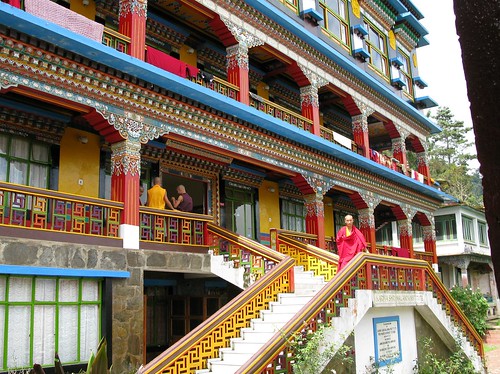
After a very late lunch we boarded the bus for our first Bhutan visit - to a monastery, where else! Very nice it was too, up on the hill overlooking the town and the river beyond, surrounded by trees and drifts of prayer flags.

prayer flags, phuntsholing, bhutan

phuntsholing from the hills

looking back to the plains

After a rest and a very nice dinner (including our first taste of ema datshi, Bhutan's classic chilli and cheese stew - super-hot chillies in a yak cheese sauce - the recipe is here if you want to try it. John, you would love it!!) a few of us ventured out for a walk, just to stretch our legs after the day's long drive. It was interesting peering into the shops, but we were nervous of getting lost and the pavements were rough - Linda has problems with her balance - so we didn't go far.

I slept very well, despite the hard bed!

24 September 2008

Day 7: Gangtok to Kalimpong

After all too brief a stay in Sikkim we were off to Kalimpong, back in India so we started out by retracing our route back to the border and then after travelling along by the river for a while, began climbing. And climbing and climbing, in sharp hairpins and even a corkscrew. We climbed 3,000ft in a very short space of time, up from the steamy valleys to the cooler hills. There was a heavy military presence here - close to the Chinese border - this time the Bombay Sappers. A huge barracks, everything ship-shape and immaculate soldiers on guard.

And then, as we drove on, the most amazing thing hove into view: a golf course, somehow carved out of a steep slope, with stunning views across the deep valley to distant hills and mountains. I didn't manage to get any photos, and we didn't pass it again, but there are some photos here that give you an idea.

We went straight to a monastery, the Zong Dog Palri Fo-Brang Gompa, also known as the Durpin monastery. It was perched on the top of a hill, with wonderful views of Kalimpong rather marred by a forest of phone masts. Everyone in India seems to have a mobile phone, even monks!
Zong Dog Palri Fo-Brang Gompa, Kalimpong

We were allowed to take photos in the temple, a rare privilege.
Zong Dog Palri Fo-Brang Gompa, Kalimpong

Zong Dog Palri Fo-Brang Gompa, Kalimpong

As you can see, it was gleaming clean and furnished with padded benches for the monks. As an even bigger treat, we were then when prayers began. I took a little film from outside to capture the beautiful chanting.


Zong Dog Palri Fo-Brang Gompa, Kalimpong

Zong Dog Palri Fo-Brang Gompa, Kalimpong

Zong Dog Palri Fo-Brang Gompa, Kalimpong

And so back to the hotel, the Silver Oaks. Here's Merle on the wonderful terrace.
merle on the terrace

There was a famous TV guru staying there too - I was too shy to take his photo or even gawp, but he was a classic guru: long flowing hair, long flowing white robes, stately progress through the hotel to the terrace, entourage trailing behind, and then holding forth rather pompously while the acolytes hung on his every word. There was a film crew with him as well.

After lunch in the splendid dining room we were off again to yet another monastery, Tongsa Gompa, the oldest in Kalimpong, built by the Bhutanese in 1692 but razed by the Gurkhas and rebuilt in 1922. Very beautiful paintings here. It's the base of yet another reincarnated lama, this time a 10-year-old who lives in Nepal. The altar was decorated with the most delicate and colourful butter sculptures, along with bowls of biscuits, bread, fruit and puffed rice. People bring the food as offerings; it's blessed by the monks, who can then eat it. A couple came in for a blessing while we were there, and then nibbled on some of the food that had been blessed as well. Afterwards we saw them outside spinning the prayer wheels. The atmosphere was really nice, relaxed but respectful.

prayer wheel, kalimpong

The next stop was quite bizarre: St Theresa's, a Catholic church designed as a gompa. The walls were painted with the stations of the cross done in Buddhist style, with Jesus in saffron robes and his mother sitting on a lotus blossom. Sadly the paintings were crudely done, so the effect was weird and ugly.

The absolute highlight of the day was the market. I had thought Gangtok's market was special, but this was even better. It runs down a street that widens out into a large covered area. You could get anything there your heart desired, I'm sure. There were clothes stalls with a sewing machine handy in case you needed alterations; hardware and kitchenware stalls; fruit and veg galore; a butcher and a fishmonger; spices and tea; jewellery and beauty products. And all in a relaxed, friendly, cheerful atmosphere. I could have stayed all day.

beans and lentils, kalimpong market

spice stall, kalimpong market

fruit stall, kalimpong market

vegetable stall, kalimpong market

fish seller, kalimpong

kalimpong girl

the happiest boy in kalimpong

I noticed something there I'd seen in Darjeeling as well - the water system. Everyone seems to have their own individual pipe, rather than sharing a common mains supply. Must make for some interesting days for the plumber...

water pipes, kalimpong

Which reminds me of another thing: I never came across any nasty smells in these hill towns. Food scraps are often left in the gutter, to be disposed of quickly and efficiently by the dogs. The toilets are pretty primitive by our lofty standards, but again, no smell, no reek of drains or sewage. It all felt very clean and healthy. Some of the party were squeamish but I felt very relaxed about hygiene - I even drank tap water, crazy reckless fool that I am!

We walked back to the hotel from the market, enjoying the relaxed vibe of the town. No-one seemed in a hurry; even when jaywalking across the main street they're ambling.

Dinner was a very nice buffet meal, after which I caught up with some much-needed sleep in anticipation of an early start.

23 September 2008

Day 6: Sikkim

A whole day of sightseeing in wonderful Sikkim. We stopped to look at some paddy fields, an idyllic scene.

a little slice of heaven

pay and use

We didn't see any other tourists, and everyone was really, really friendly.

we have the same shoes!

We passed a lot of children walking to school. They start very young, three and a half, so there were some tiny little dots getting along the road in their uniforms with backpacks on. Really, really sweet!

It was a day of many monasteries. The first one was Rumtek, the biggest in Sikkim. I found the temple there a bit odd. Rumtek is the base of a reincarnated lama, the Karmapa Lama, who lives in Dharamsala (there's some controversy about whether he really is the reincarnation; another monk is also claimed to be the Karmapa. Read about it here. The Karmapa is head of the Black Hat sect. Anyway the odd part for me is that the main temple, a huge, wonderful space with gorgeous wall paintings, thousands of buddha images and hangings, has a great wall built at the back, right in front of the main statue of the Buddha. In front of the wall, facing the monks, is the throne of the Karmapa, with a big photo of him sitting in it. There's about two feet of space between the front of the altar and the wall - you have to squeeze in to see it. It's almost as if they are so obsessed with the idea of reincarnated holy men that they've discounted the holiest of all, the Buddha. You can't take photos in there, but it was very beautiful.

Skipping ahead a little, I asked our Bhutan guide about this thing of the importance of the lamas. He said that in Tibet the monks had focused too much on different sects and chosing lamas and had fallen out over differences. China had been able to take advantage of their lack of unity and take over. In Bhutan, however, although they have loads of reincarnated lamas there are no sects, and they focus more on Buddha and his teachings. Thus no-one had ever conquered them, because they were united.

Back to Rumtek: upstairs there was an elaborate gold stupa studded with coral and turquoise that has the ashes of the previous incarnation of the Karmapa in it. A little boy monk was minding the shop. There was a mat set up in a corner with a low table holding a scripture - long rectangular sheets threaded together between wooden covers - and he was supposed to be sitting there studying it. But he was listening to the radio, a little tranny plugged into the shonkiest bit of electrics, a fuse board fitted with sockets. Gurmay ticked him off for having it on too loud - he was flipping through the stations, wee tyke.

rumtek monastery, sikkim

wall painting, rumtek monastery

rumtek monastery, sikkim

rumtek monastery, sikkim

prayer wheels, rumtek monastery

rumtek monastery, sikkim

We also visited Enchey, a very old monastery that was damaged in an earthquake or a fire or both (it was all a bit vague) and is now being repaired, restored and expanded. It was fascinating seeing the work going on. Most was being done in very traditional ways, but some of the carving was in wet cement rather than wood, so as to be more fireproof I assume.

young monks

monastery being renovated

Another highlight of the day was a visit to a handcraft factory - we saw artisans at work painting, carving, weaving and sewing. The painting was really interesting, very detailed and beautiful thangkas or devotional images. We learned more about this in Bhutan.

painting a thangka

painting a thangka

A real treat awaited us at the hotel that evening. Unknown to us, Gurmay had organised a meal featuring local cuisine - including millet beer. Not quite sure if beer is the right word; to me it tasted more like sake. It's made from fermented millet - Gurmay told us the process and it all sounded like far too much work, involving kneading and proving mushed-up seeds - which is put in the bottom of a special hollow bamboo pot. You pour boiling water on this and leave it to work for five minutes or so. You then drink it through a special bamboo straw. This has a slit in the end so you don't end up with a mouthful of a mushed-up millet. It tasted quite potent and was very warming. You keep topping it up with boiling water, and eventually it doesn't taste alcoholic any more - that's when you're done.

I drank quite a lot but didn't feel drunk - though my face did go very red! Gurmay said the typical scene is a couple of farmers who've worked hard all day in the fields settling down around the fire with a couple of pots and sipping away on it until it's time for bed.

The menu highlight was fiddlehead ferns, which taste a bit like asparagus. There was also a spinach curry and some glass noodles - it was lovely.