

We didn't see any other tourists, and everyone was really, really friendly.

We passed a lot of children walking to school. They start very young, three and a half, so there were some tiny little dots getting along the road in their uniforms with backpacks on. Really, really sweet!
It was a day of many monasteries. The first one was Rumtek, the biggest in Sikkim. I found the temple there a bit odd. Rumtek is the base of a reincarnated lama, the Karmapa Lama, who lives in Dharamsala (there's some controversy about whether he really is the reincarnation; another monk is also claimed to be the Karmapa. Read about it here. The Karmapa is head of the Black Hat sect. Anyway the odd part for me is that the main temple, a huge, wonderful space with gorgeous wall paintings, thousands of buddha images and hangings, has a great wall built at the back, right in front of the main statue of the Buddha. In front of the wall, facing the monks, is the throne of the Karmapa, with a big photo of him sitting in it. There's about two feet of space between the front of the altar and the wall - you have to squeeze in to see it. It's almost as if they are so obsessed with the idea of reincarnated holy men that they've discounted the holiest of all, the Buddha. You can't take photos in there, but it was very beautiful.
Skipping ahead a little, I asked our Bhutan guide about this thing of the importance of the lamas. He said that in Tibet the monks had focused too much on different sects and chosing lamas and had fallen out over differences. China had been able to take advantage of their lack of unity and take over. In Bhutan, however, although they have loads of reincarnated lamas there are no sects, and they focus more on Buddha and his teachings. Thus no-one had ever conquered them, because they were united.
Back to Rumtek: upstairs there was an elaborate gold stupa studded with coral and turquoise that has the ashes of the previous incarnation of the Karmapa in it. A little boy monk was minding the shop. There was a mat set up in a corner with a low table holding a scripture - long rectangular sheets threaded together between wooden covers - and he was supposed to be sitting there studying it. But he was listening to the radio, a little tranny plugged into the shonkiest bit of electrics, a fuse board fitted with sockets. Gurmay ticked him off for having it on too loud - he was flipping through the stations, wee tyke.


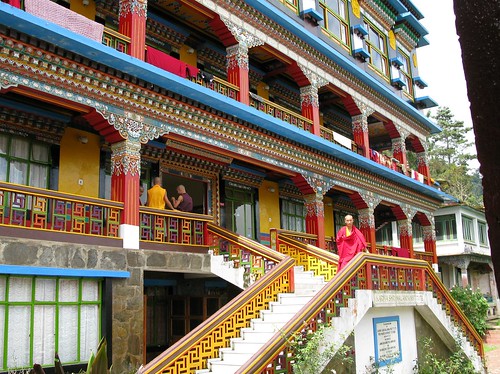


We also visited Enchey, a very old monastery that was damaged in an earthquake or a fire or both (it was all a bit vague) and is now being repaired, restored and expanded. It was fascinating seeing the work going on. Most was being done in very traditional ways, but some of the carving was in wet cement rather than wood, so as to be more fireproof I assume.


Another highlight of the day was a visit to a handcraft factory - we saw artisans at work painting, carving, weaving and sewing. The painting was really interesting, very detailed and beautiful thangkas or devotional images. We learned more about this in Bhutan.


A real treat awaited us at the hotel that evening. Unknown to us, Gurmay had organised a meal featuring local cuisine - including millet beer. Not quite sure if beer is the right word; to me it tasted more like sake. It's made from fermented millet - Gurmay told us the process and it all sounded like far too much work, involving kneading and proving mushed-up seeds - which is put in the bottom of a special hollow bamboo pot. You pour boiling water on this and leave it to work for five minutes or so. You then drink it through a special bamboo straw. This has a slit in the end so you don't end up with a mouthful of a mushed-up millet. It tasted quite potent and was very warming. You keep topping it up with boiling water, and eventually it doesn't taste alcoholic any more - that's when you're done.
I drank quite a lot but didn't feel drunk - though my face did go very red! Gurmay said the typical scene is a couple of farmers who've worked hard all day in the fields settling down around the fire with a couple of pots and sipping away on it until it's time for bed.
The menu highlight was fiddlehead ferns, which taste a bit like asparagus. There was also a spinach curry and some glass noodles - it was lovely.


No comments:
Post a Comment