
What's going on on the steps there is a school project. The pupils (in purple and blue) were setting up a health check - they were planning to measure people's height, weigh them and take their blood pressure. They want to study whether the more sedentary modern lifestyle is causing health problems.
After that, we visited the school for tradtional crafts - painting, embroidery, metalwork, carving, weaving.


The embroidery was very fine work, a combination of applique and stitches so perfect that the back was as neat as the front. All the trades seemed to be six-year courses. And they were treated as trades - there was very little creative work. The emphasis was on the perfection of technique by copying traditional designs. The idea is that graduates can set up in business in their chosen trade.
In the drawing class one boy showed us his worksheets for just one design. He copied it in pencil, using set square and protractor to get the angles and proportions right, then painted over the lines in black ink using a brush so fine it was just a couple of hairs. The teacher marked in red where the design went wrong. Each copy had fewer and fewer red lines, until finally one was awarded a tick - perfect! Then it was on to the next design. This was the first year of the painting course - we didn't get to see any actual painting, which was a bit disappointing. I think all the classes we visited were first-years.

After touring around the classrooms it was on to the school's shop, where I bought some paintings and a necklace. The paintings are lovely - the ones I got for myself are a buddha and a wheel of life. The necklace was a last-minute whim purchase - I thought it was ceramic beads. But later on I realised it was wood and bone inlaid with coral and turquoise, with silver spacers and beads. The fastening is a cunning slider made by knotting the cord. Very, very nice!
The decoration above the shop door caught my eye:

A fertility symbol - you see them everywhere. Didn't see any for sale though!!
Next stop was a folk heritage museum. According to the itinerary we should have visited the national library but it's closed at the weekend. It was the same with the national museum in Paro - we were there on a Monday but it's closed on Mondays.


The actual museum at the folk heritage museum was also closed, but we still got to see the best part - a traditional house. It was pretty interesting - the animals were kept in the ground floor, the second floor was storage, then upstairs from that the kitchen, livingroom etc, plus a chapel room, and then an open upper floor under the roof, for drying hay, veges and so on. It was all very airy and open and sturdy, and all the implements and furniture were nice too - plain and practical, apart from the chapel of course, which was hung with brocade banners.


Outside there was a water-driven prayer wheel and flour mill, plus fields of rice, corn and other vegetables, and apple trees.


After that we did some more shopping, this time at the Handicraft Emporium, a wonderful big shop chock full of goodies. Oh to have a huge suitcase and unlimited funds!! Some of the group went a little mad in there: Christine bought a whole Bhutanese outfit - the skirt, blouse, jacket and belt. She looked really lovely in it. She also got an incredibly beautiful embroidered jacket - soft cashmere hand-embroidered all over with flowers in jewel colours. Judy gto a jacket too.
Back to the hotel then to offload our booty and have lunch - another tasty feast. And on to our next hightlight, the Tashichhodzong, "the fortress of the glorious religion". It's a giant complex, housing both the offices of the king and of the head of the monastic body. It was built in 1962 after the original place burnt down - a real hazard when everything's built of wood.
For the visit to the dzong, Tshering put on his special shawl, or kabney, the colour of which (white) shows his status as an ordinary person. Various other colours and styles and methods of tying show gradations of status and authority. He pointed out a soldier who was wearing a gho rather than a uniform, but who was wearing a sash that showed his military authority.

There were other rules too: no hats or head coverings of any kind, including umbrellas (though I couldn't help but notice this didn't apply to soldiers in uniform, whose berets stayed firmly on). It was still raining so this caused consternation in the group, some of whom had a horror of getting even a wee bit damp. We did a lot of hovering under the eaves and dashing across courtyards. There's a little film on youtube that shows Chotse Penlop, the new young king, at Tashichhodzong - you can see some of the elaborate shawls the high ranks wear.
Back on earth, after our bags were searched we were allowed through to the courtyard. Here are some of my photos:


No photos in the main temple of course, so I took a lot of very careful mental snapshots, because it has just been repainted for the young king's coronation in November, so it is looking particularly spectacular. It's a huge space - double or triple height in the centre and with a deep mezzanine. The ceiling height soars even in the mezzanine, so the whole effect is light and airy. Three walls are covered in images of the Buddha - paintings on the back wall and part of the side walls, and glassed-in niches with little statues on the rest of the wall space.
In pride of place is a huge golden Buddha, a shimmering vision at least two storeys high. Curving over him is an archway carved with animals and flowers and leaves, painted in vivid colours in stunning detail. In front of the Buddha are two low thrones, one for the king and one for the head monk. They are carved with dragons, gilded on a red background with touches of white highlights - again, in gorgeous detail and skill. The cushions are yellow brocade silk.
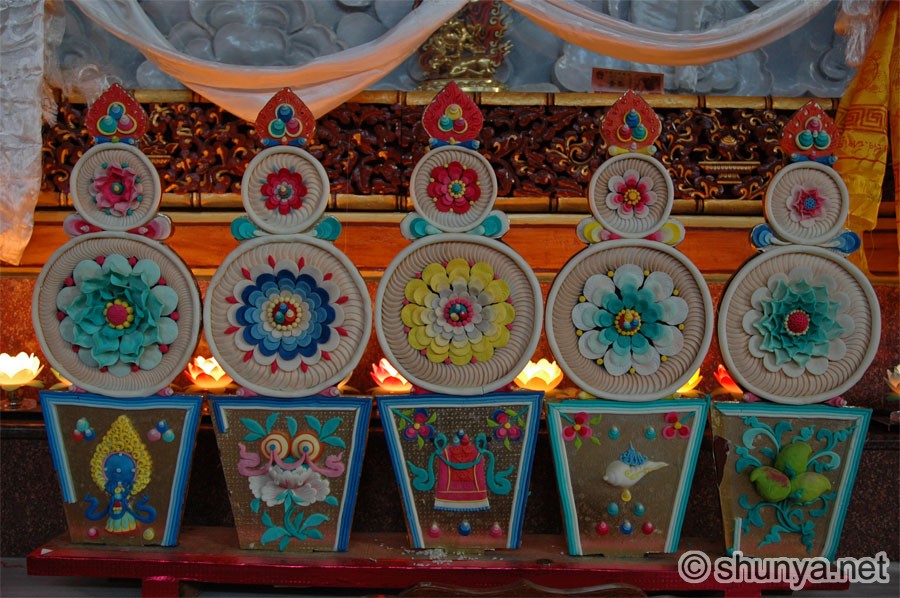
At either side of the Buddha are the Bodhisattva - the Buddha before enlightenment - and the future Buddha, Maitreya, both statues gorgeously painted. In front of the altar were the offerings, including the lovely butter ornaments the monks make. Here's a link to a photo of some Tibetan butter sculptures to give you an idea of how beautiful they are.
The benches for the monks are covered in rugs and brocade, very plush-looking. The overall effect is intensely decorated. It reminded me of some of the cathedrals I've seen in France.
There was no chanting going on while we were there, because it was Sunday - the monks' day off!
Back in the bus, we stopped on the hill to look back at the dzong:

Our next stop was to view a real oddity, the national animal. It's the takin, an animal so unusual it took DNA research to show that even though it looks a bit like a goat or an antelope or a musk ox, it's more related to sheep.
Needless to say, the myth of the takin is much more entertaining: it was created by a visiting lama, Drukpa Kunley ("the divine madman"), in the 15th century. A crowd of devotees wanted him to perform a miracle, but he wanted to eat first, and demanded a whole cow and a goat. He scoffed the lot, leaving the bones. And then he stuck the goat's head on the cow's bones and voila! With a snap of his fingers there was the takin, which immediately started grazing. Kunley was renowned for his ability to enlighten people, particularly women ... and he's commemorated in the many, many phallic symbols you see in Bhutan.
Anyway, the takin we saw were in a nature reserve. The story goes that there used to be a zoo, but the king decided zoos weren't compatible with right living, so all the animals were released. But the takin didn't take to freedom and ended up roaming the streets of Thimpu looking for food. So a nice low-key reserve was created for them and they live happily in fenced-off fields.
No pix of the takin, but here are some very cute puppies instead:

The final stop was rather nice - a chorten or stupa built to commemorate the late king. None of my photos were any good so I won't bore you with them ... have a look here. It was really nice to visit. People come and walk round the building saying prayers. The atmosphere is tranquil and contemplative. People of all ages were there, from grannies to school kids, all just circling the stupa quietly or spinning the prayer wheels off to the side.
We went out to dinner, to a restaurant called the Bhutan Kitchen. It was a nice place, with low tables and low stools, and a man playing a dulcimer. Sadly most of the food we had was carefully de-spiced, but there was a fully-charged dish of chillies and cheese, yum! We had a lovely evening, really nice.


And so to bed... but not before I'd joined a few of the others in the Druk's cocktail bar. What a bizarre place! I had a pina colada, which made the barman's night - he loves making cocktails and hardly ever gets to do it. And no wonder! The bar had the most hideous, oppressive decor, with weird ugly colours and mad industrial furniture - steel tables and stools with bicycle seats. But the drink was great! The best pina colada I've ever had.
And the excitement didn't end there - there was a mini-riot in the street outside the hotel very late on, with a lot of shouting and screeching (in English, I might add, so not involving locals), and that set the dogs off. Between that and the hard beds, I don't think anyone got much sleep.



No comments:
Post a Comment