Remember it had been raining for the previous three days - the clouds had been hanging low over the hills the whole time. We were at a point the previous day when we should have been able to see the monastery but couldn't. But Tshering told us today was an auspicious day to visit it - the last day of the eighth month of the lunar calendar or some such. Yes, I just checked it and it is the last day of the eighth month of the year of the mouse (rat, actually). Very auspicious. So I was sure it would work out fine, even though the nay-sayers were saying nay very loudly.
Walking up steep hills for two and a half hours wasn't everyone's idea of fun - Judy was ill, poor thing, and Mike stayed on at the hotel to minister to her; and Merle the New Yorker was happy to spend the day checking out life in downtown Paro. Of the rest, just Susan, Duncan, Christine and I went all the way to the monastery. Desi, Denis and Lynday stopped at the cafeteria halfway up.
The day looked promising when we set out in the bus and soon we got our first glimpse of our goal.

The path initially was quite straightforward - wide, a little muddy but not too bad, and not too steep. I took it at a steady pace, enjoying the chance to have a good walk after so much sitting round in buses and cars. I was really pleased to have packed my walking stick, though Tshering had brought along some nice wooden ones. There were quite a lot of other people walking the path - a lot of locals, because it was an auspicious day, and a lot of tourists of course. And dogs! There were dogs all along the path.
At one point an American woman overtook me at speed, wheezing and puffing. "Hello doggy!" she yodelled at a dog that happened to be sitting there. "Hello doggy!" She completely ignored me - SO not cute! A bit further on I came across her again. She'd caught up with a friend, and they were having a wee at the side of the path! I was tempted to call out "Hello doggy!" A bit after that they overtook me again, again ignoring me, huffing and puffing. I finally passed them near the cafeteria - they'd stopped for a breather.
I'd love to come back and do the walk in spring - there were loads of rhododendrons and orchids on the way up, it must be really pretty.
After an hour's walk we got to the cafeteria - Susan in the lead, then me, then the others. We stopped there for a cup of tea and to admire the view.


The funny thing was that as Susan and I stood there gaping at the scene and taking photos, the American women showed up and noisily greeted the rest of their party. "Wow I'm really out of breath, naw, don't need the bathroom, took a leak on the way up, oh great, tea, is there anything to eat?" and so on and on, all at the top of their lungs. And while they yakked, the cloud quietly closed in, shrouding the monastery. "Hey, where's my view gone?" bellowed one of them, finally noticing. Hee hee. I did feel a bit smug.
There were cats as well as dogs at the cafeteria, all with well-honed techniques for polite begging.

Further up from the cafeteria the vegetation changed - now we were up among the clouds there were more orchids and ferns and spanish moss.


It was hard to get a really good photo of this - the colours were very rich and striking, russet and jewel green - these shots are a bit washed-out.
All along the path there were reminders that we were in a holy place. Bit of background: Taktsang got its name because it's the place where Guru Rinpoche meditated after arriving in Bhutan on Yeshe Tsogyal, his flying tigress-consort. This was in the 8th century. The monastery was built in the 17th century. In 1998 a good part of it burnt down (like so many buildings in Bhutan! a combination of well seasoned wood, devotional lamps and a lack of firefighting equipment), but it was rebuilt in what must have been an incredibly difficult project.
So, Taktsang having been a place of pilgrimage for more than 1,200 years, the pathway leads not just to the main monastery but to several other smaller temples and caves and retreats. The monks at Taktsang stay just a few months, but in some of the retreats monks come for three years, three months and three days. They have just one meal a day and spend most of their time in meditation.
Here's a holy spot with a collection of miniature stupas. These are little terracotta cones moulded with a hollow bottom, into which something commemorating a deceased person is put - it might be ashes, a photo or a piece of scripture.

I don't know what this was about - I like to think it was a nice little prayer rather than something like "take your litter home".

Not that they would say anything that crass:

And of course there were the dogs to keep us company.


At this point the path went from being reasonably easy going to being very difficult indeed, at least for someone like me with bum knees. I took a couple more ibuprofen and contemplated the view. At the point the path went very steeply down to the left of the picture below, then very steeply up again. I thought maybe they got the prayer flags across the gorge by shooting an arrow across with a bit of string tied to it; but no, they take one end and the string of flags and trudge down the steps and back up the other side.

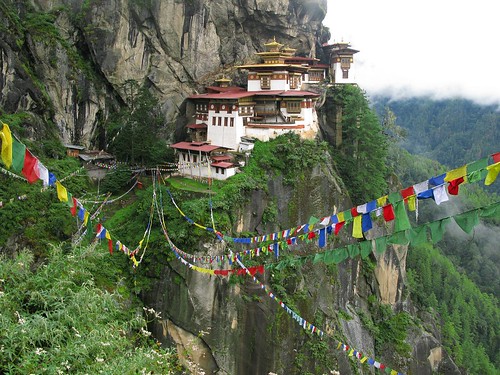
But before we started down the steps we stopped at the butter lamp chapel. Ah yes, they have learned a thing or two: the butter lamps are kept well away from the monastery.

It was the sweetest little place, shimmering and cosy with the light and warmth of dozens of butter lamps. We lit one for each member of the party, plus one for Tshering and his family, and then Duncan lit one for his late wife - so he had to light another one to make it an odd number - it's auspicious.

I realised later that I hadn't taken a photo of the monk - that's his bare foot in the bottom left-hand corner! He was very nice, shy and smiley.
Then it was down down down the steps to the bridge across the stream at the foot of the waterfall.


Just past the waterfall is a tiny little pilgrimage site, Senge Phug, one of the nine sacred caves at Taktsang.

And then up and up and up and up to the entrance, where we had to shed our bags and cameras, submit to being frisked, and then put on our jackets.

Just when I was feeling pretty good about having made it there, I saw the next lot of steps leading up inside the monastery. Great big tall stone steps, two flights of really really steep steps. Just as well I was allowed to keep my stick! Off I went, up and up and up. And it was well worth it.
The main temple is a jewel box, a gleaming gem painted with images of the Buddha and Guru Rinpoche. There's a statue of the guru as well, and piles of offerings. Every detail is exquisite, the door, the door handle, the statues, the paintings. But the highlight was in one corner: a huge gilded door with a little window in it, through which you can peer in to the actual cave where the guru meditated. It is decorated and hung with white silk scarves, but it is clearly a cave, a deep cleft in the rock.
After viewing the cave, we each received a blessing from the monk - you give a donation, chose a symbol from a little basket and he tied it around your neck while murmuring a prayer. I have a phurbu, a ritual dagger, with a dorje or thunderbolt on the handle. It's more like a three-sided tent peg than a dagger, and symbolises the overcoming or cutting through of the three poisons of ignorance, greed and hatred. The dorje symbolises cosmic energy in its pure form. (Fascinating Fact: Darjeeling comes from Dorje Ling, Place of the Thunderbolt.)
Tshering made three full prostrations in front of the guru statue. He says if you meditate in this temple he will sometimes speak to you. "But so far, nothing," he said cheerfully.
We had a look out over the gorge from a balcony just down from the temple, then went around the corner and up some more steps to see the cave where Yeshe Tsogyal, the flying tigress and consort and enlightened being, the Queen of Bliss, meditated. No fancy temple, no gilded door, just a plain cave.
And then it was back down down down the steep stone steps. A Bhutanese woman coming down behind me said, "Same! Same! Sore knees!" and gave me a helping hand. We got chatting and she asked where I was from. "Edinburgh," I said. "I've been there," she replied. Her husband went to university in Scotland, studied agricultural science. She was murmuring mantras as we walked along.
For some reason I didn't take many photos on the way back down down down the stone steps and back up up up the stone steps - rather too busy staying alive!

The dogs were still tooing and froing along the path. They seem to have quite a nice life.


The cairns on the path reminded me of hillwalking in Scotland.

At one point we had to wait to let some monks go past with ponies carrying supplies for the monastery.

Finally we reached the cafeteria, where we had lunch. The food is all vegetarian, because it's a holy place. It's cooked on wood stoves in a very basic (and smokey) kitchen and served in a buffet in the large dining room. We ate outside.

The animals were quite restrained.

Just near the cafeteria some ladies were selling necklaces and so forth from blankets spread on the ground. They called out "shopping, shopping" as soon as we hove into view. I'd had a look on the way up and knew what I wanted - some yak-bone prayer beads. I negotiated a price I was pleased with and the seller was very pleased with. I got one set for Anthea and one for myself. I love them - they're very plain and simple and very heavy.

She's smiling with her mouth shut because her few remaining teeth are stained red with betel nut. She's a sweetie.
On the way back down the hill we came across a team of litter-pickers. I asked them to pose so I could send a photo to the CleanFerry group - litter-picking is one of my hobbies.

After the long walk I was pretty knackered but elated. The bus was waiting and we drove in to town for a quick bit of shopping before heading back to the hotel for a well-earned shower and a rest. We went out for dinner to a very nice restaurant in Paro - delicious food. There was a real treat in the buffet lineup: yak goulash. John will be thrilled to know that Hungarian cuisine has reached the furthest corners of the world! It was delicious, by the way. And it was a proper goulash too, yum.
After such an action-packed day I slept very well that night.


No comments:
Post a Comment